Published on June 8, 2026
The Future of Food Begins in Northeast Brabant
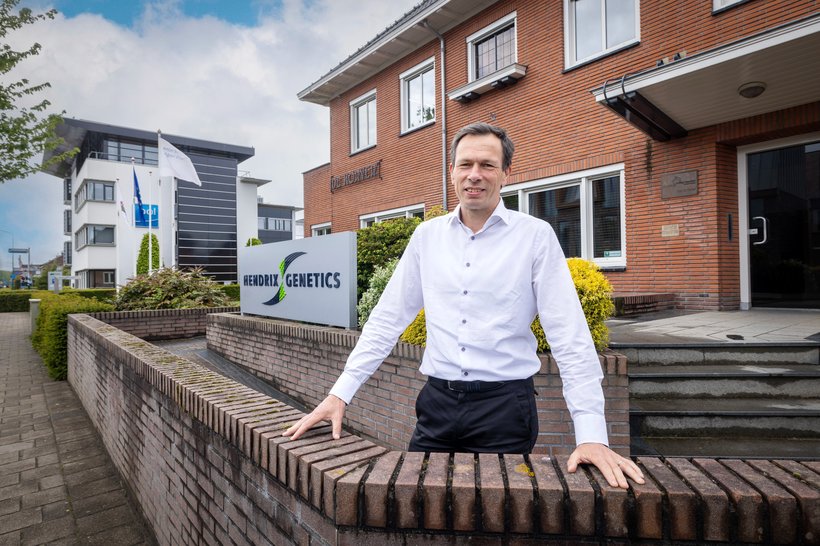
How will we feed more than 10 billion people by 2050, while reducing our impact on the planet? From the Northeast Brabant region, Richard Maatman, CEO of Hendrix Genetics, sees a significant part of the answer taking shape. Within a powerful agrifood ecosystem, where knowledge, technology, and collaboration come together, solutions to the global food challenge are being developed every day. According to Maatman, the key lies not in producing more, but in producing smarter: using data, genetics, and innovation to gradually make the food chain more sustainable and efficient. From Boxmeer, impact is being built that reaches far beyond the region.
In Northeast Brabant, everything comes together to help address one of this century’s greatest challenges: feeding the world sustainably. With leading companies such as Nutreco, Stork, Intervet, and Hendrix Genetics, a strong agricultural sector, and close collaboration with knowledge institutions, the region stands out as a unique hub for innovation. Richard Maatman describes it as: “A place where challenges and bright minds meet.”
He believes this region plays a crucial role for the future: “We need to be much more aware of the strength of this region. A large share of the solutions to the global food challenge is developed here.”
Leading Through Knowledge
The challenge is clear: by 2050, the world will need to produce around 40% more food, while drastically reducing its ecological impact.
Maatman explains: “If we use all available technologies, we can produce what is needed with significantly lower emissions than today. Genetics plays a key role in this. Within a 400-kilometer radius around the Netherlands, the North Sea Innovation Cluster, the majority of agrifood innovations are developed. This is where technology, entrepreneurship, and knowledge come together at a global level.”
According to Maatman, the Netherlands can – and must – make a difference, not by being the lowest-cost producer, but by leading in knowledge and innovation.
“Our home market is too small. We need to succeed internationally, and we do so through knowledge and added value. The collaboration between businesses, government, and knowledge institutions – the “triple helix” – forms the foundation of this success. That infrastructure defines our region and has enabled us to grow.”
A Data-Driven Technology Company
As a globally operating company, Hendrix Genetics stands at the very beginning of the food chain. Developments that start today may only have an impact on the market years later.
Maatman says: “We work five to ten years ahead. What we develop today determines what the food chain will look like in the future. The dynamics differ by region. Topics such as animal welfare and sustainability evolve at different speeds around the world and require tailored approaches in genetics and innovation.
The agrifood sector has rapidly transformed into a high-tech environment, where data and technology play a central role. At our core, we have become a data-driven technology company. Through applications such as genomics, AI, sensor technology, and even CT scanning, Hendrix Genetics works on healthier animals, greater efficiency, and a lower environmental footprint. The impact is tangible: in 1970, a laying hen produced around 250 eggs. By 2030, this is expected to exceed 500 eggs per cycle. At the same time, animals are more robust, live longer, and contribute to lower feed costs and reduced environmental impact. Each year, efficiency, animal welfare, and sustainability improve by around 3% through genetic progress, and the pace of improvement continues to accelerate.”
Collaborating Across the Value Chain for Real Impact
Innovation goes beyond technology. It requires collaboration across the entire value chain to create real impact.
Maatman explains: “We never innovate alone. Together with farmers, retailers, and partners, we anticipate market needs. With partners such as Rijk Zwaan, we align developments in both animal and plant-based production. Cross-sector collaboration, with other industries, startups, and knowledge institutions, accelerates innovation.
To maintain a strong position in agrifood, attracting new talent is essential. However, this inflow is under pressure both regionally and globally. That’s why we must remain an attractive employer and region, offering good working conditions, a high quality of life, and increasingly, a strong sense of purpose.
In addition, maintaining a strong primary agricultural sector in the region is critical: without farmers, the innovation cluster disappears. You need that critical mass to continue innovating.
The Netherlands holds a strong and visible international position in agrifood: wherever you go in the world, there is almost always a Dutch company in the top three. We can be proud of that. But that position also brings responsibility. The next question is: how do we fully use this strength to help solve the global food challenge? At Hendrix Genetics, we are fully committed to doing just that.”
Hendrix Genetics has its roots in the Boxmeer region, where it remains deeply anchored. What began in 2005 has since grown into a globally leading company in animal breeding, genetics, and technology. From its regional base, the company develops innovative and sustainable genetic solutions for turkeys, laying hens, broilers, swine, and aquaculture species such as salmon, trout and shrimp. With more than 3,000 employees and operations in over 25 countries, Hendrix Genetics has built a strong international presence, while maintaining a close connection to its region of origin.
Article translated and retrieved with permission from AgriFood Capital.