Published on Nov. 23, 2026
New Research on Genetic Resistance to SRS in Salmon
How can genetics contribute to healthier and more resilient salmon? At the first SRS Conference in Chile, Hendrix Genetics shared research exploring genetic resistance to Salmonid Rickettsial Septicemia (SRS), one of the most significant health challenges facing Chilean salmon farming.
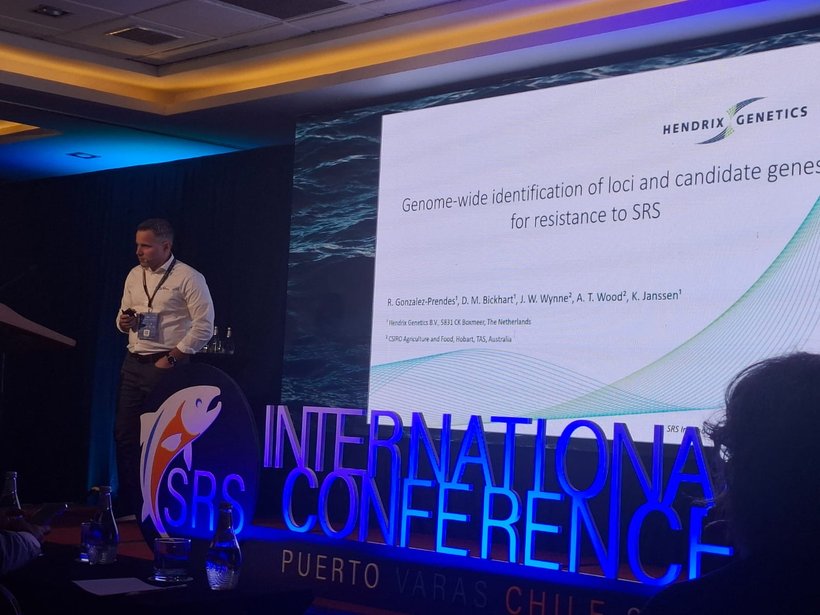
From November 9 to 11, 2026, researchers and industry representatives gathered in Puerto Varas, Chile, for the first SRS Conference, dedicated to advancing knowledge and collaboration around Salmonid Rickettsial Septicemia (SRS).
Hendrix Genetics participated in and sponsored the event, joining other players from across the salmon industry to exchange research, perspectives and potential approaches to this major health challenge.
At the heart of our participation was research presented by Dr. Rayner González-Prendes, bioinformatician at Hendrix Genetics, exploring how a better understanding of the Atlantic salmon genome could help strengthen selection for SRS resistance.
Looking Deeper Into the Genetics of SRS Resistance
In his presentation, “Fine-mapping SRS resistance in Atlantic salmon to improve genomic selection and identify gene-editing targets,” Rayner shared research conducted by the Hendrix Genetics team to better understand the genetic differences that may influence SRS resistance in Atlantic salmon.
The team analyzed data from more than 10,000 Atlantic salmon after infection with Piscirickettsia salmonis, the bacterium responsible for SRS. By studying their genomic information and survival, the researchers looked for regions of the genome that could be associated with greater resistance to the disease.
The analysis identified significant genomic regions, as well as several candidate genes linked to functions such as cellular organization and programmed cell death. These findings provide biological hypotheses for further investigation, including how these processes may influence the immune response to infection.
However, no single genetic marker explained a large proportion of the differences in resistance.

We did not identify a single Quantitative Trait Locus (QTL) with a large effect on resistance. What we found were some QTLs with rather small effects.
This suggests that SRS resistance is a polygenic trait: rather than being driven by one major genetic factor, it is influenced by many genetic variants, each contributing a relatively small effect. These findings confirm that genomic prediction, as currently employed in Hendrix Genetics’ breeding program, is an effective method for genetic evaluation.
From Genomic Information to More Precise Selection
Conventional genomic prediction tools, like single-step GBLUP, are suitable for polygenic traits but cannot account for genetic markers with large effect. Despite SRS resistance being largely polygenic, genomic prediction methods that account for markers with large effect may further boost the accuracy of genomic prediction for SRS resistance.
Similar approaches in trout have shown that changing how existing genomic information is modelled can improve prediction accuracy.
For Hendrix Genetics, the objective is to translate this deeper understanding of SRS resistance into more precise genomic evaluations and, ultimately, better-informed selection decisions and faster genetic progress.
The research continues by further investigating the role of the identified candidate genes through gene-expression analysis and other functional validation methods.
Progress Through Collaboration
The conference brought together researchers and industry players approaching SRS from different perspectives, creating an opportunity to exchange knowledge around a challenge shared across the Chilean salmon farming sector.
For Hendrix Genetics, bringing genetic research together with the expertise of producers, veterinarians, scientists and other partners is essential to turning scientific knowledge into practical progress for salmon health.
Breeding for Healthier and More Resilient Salmon
Our research on SRS reflects a broader ambition within Hendrix Genetics: using genetics to support healthier and more resilient animals. Continued investment in research and genomic technologies helps us better understand complex health traits and incorporate this knowledge into our breeding programs.
The work presented in Chile is one example of this long-term approach. By transforming increasingly precise genetic knowledge into better-informed selection decisions, we aim to contribute to healthier fish and a more resilient future for salmon aquaculture.